Machine Learning
Road Accident Analysis System
Comprehensive machine learning pipeline for emergency response optimization, comparing multiple algorithms to achieve high accuracy in critical medical predictions.
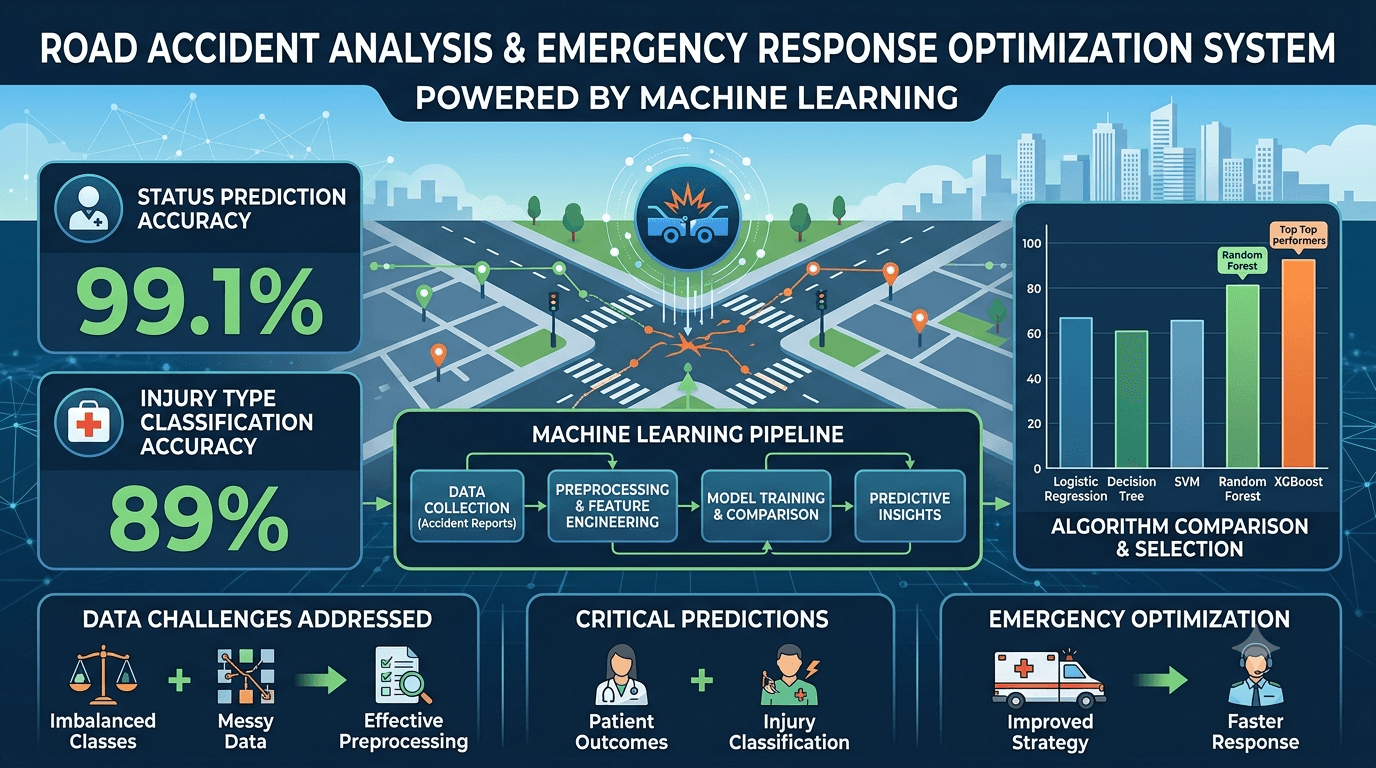
Key Features
- Predictive models for patient status and injury type classification
- Comparative analysis: Logistic Regression, Decision Tree, SVM, XGBoost, Random Forest
- Achieved 99.1% accuracy for patient status prediction
- 89% accuracy for injury type classification
- Data preprocessing and feature engineering pipeline
- Insights for improving emergency response strategies
Challenges Faced
- Highly imbalanced classes between severe and minor injury outcomes skewed early models
- Choosing among several ML algorithms without overfitting to the training set
- Extracting meaningful features from messy, real-world accident report data
Solutions Implemented
- Built a thorough preprocessing and feature engineering pipeline before modeling
- Compared Logistic Regression, Decision Tree, SVM, XGBoost, and Random Forest to select the best performer per task
- Reached 99.1% accuracy for patient status and 89% for injury type through careful tuning and validation
More Machine Learning Projects
View All
Machine Learning
FeaturedTimeClipAI: Real-Time Action Classification
Framework for online temporal action localization using Anchor Transformers
- Real-time action classification and time segmentation in videos
- Support for EGTEA, EPIC-Kitchen 100, THUMOS'14, CricShot10 datasets
- Pre-trained I3D features for efficient training/testing
PyTorchPythonComputer VisionTransformersVideo Analysis+2
Get in touch
Curious how it was built?
I'd be glad to walk through the architecture and decisions behind Road Accident Analysis System.